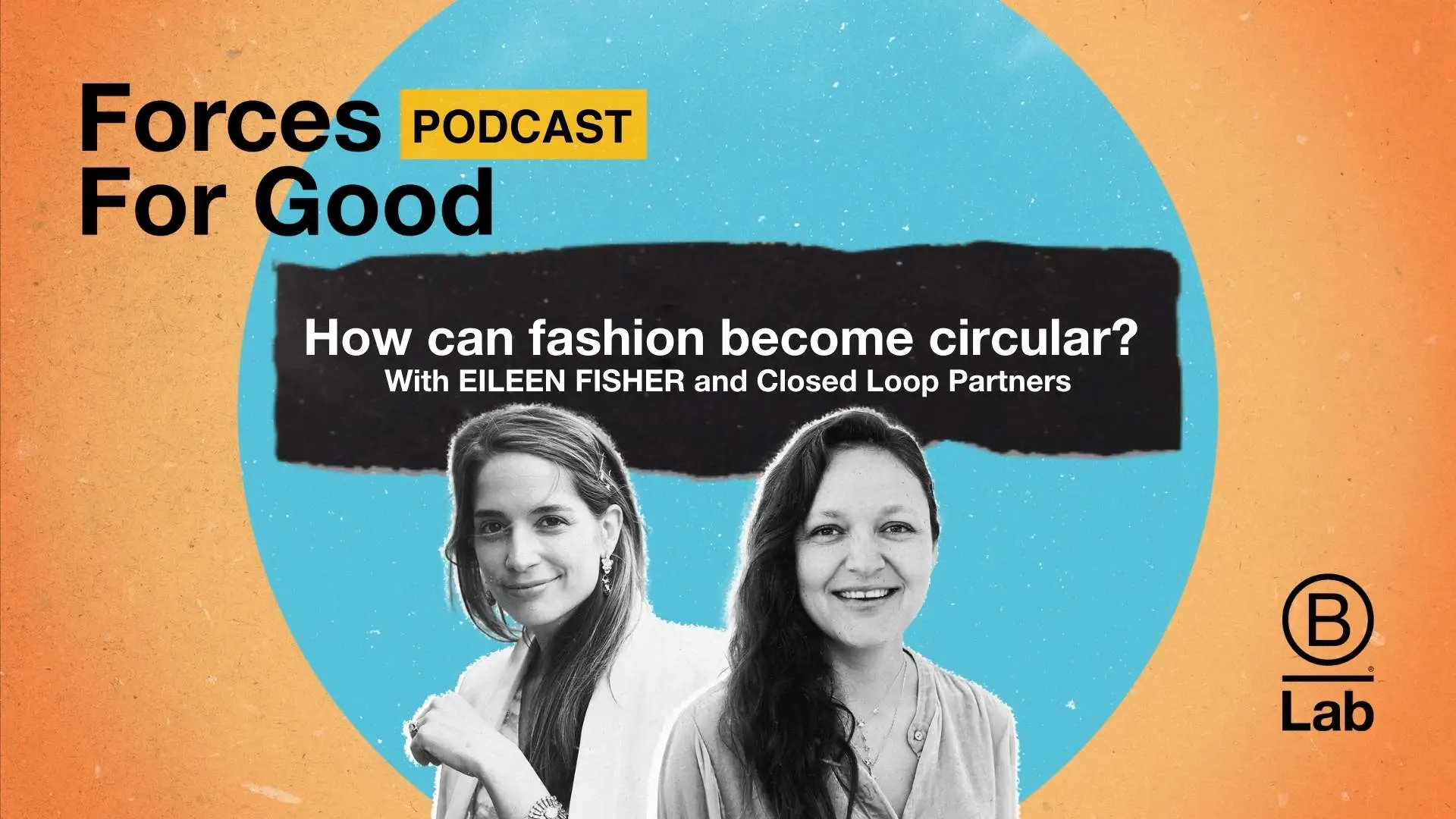
Forces For Good Podcast Season 4 — Episode 5: How can fashion become circular? with EILEEN FISHER and Closed Loop Partners
The fashion industry accounts for as much as 10% of global emissions, but the sector is also becoming a proving ground for circular innovation.
In this special live episode of Forces for Good, recorded during New York Climate Week at Remake World’s Wear Your Values Weekend, we sat down with two leaders driving that change: Carmen Gama, Director of Circular Design at B Corp Eileen Fisher, and Lily Oswald, Director of Growth & Strategy at Circular Services, the largest privately held recycling company in the U.S.
Surrounded by an audience of emerging fashion and solutions designers, we explored how circular systems, regenerative thinking, and bold collaboration can reshape the future of apparel. Listen now: https://lnk.to/Forces-For-Good-Fashion-Circularity
TRANSCRIPT: Episode 5 — How can fashion become circular? with EILEEN FISHER and Closed Loop Partners This is Forces for Good, a podcast from B Lab, the nonprofit network powering the global B Corp movement. I’m your host, Irving Chan-Gomez.
Forces for Good takes a hard look at how businesses are helping to solve the biggest social and environmental challenges of our time.
Welcome to a very special episode recorded live in New York City at the intersection of Climate Week and Fashion Week.
Our goal this season is to highlight some of the toughest climate challenges and showcase some of the most promising solutions. So we have to talk about fashion. We'll get into the stats, the why and the solutions with our amazing guests. Carmen Gama is Director of Circular Design at B Corp, Eileen Fisher, and co-founder of Make ANEEW
Lily Oswald is the Director of Growth and Strategy at Circular Services, a Closed Loop Partners Company. It's the largest privately-held recycling company and circular economy service provider in the US.
Before we get started I want to tell you what gives me hope that even the toughest climate challenges can be solved.
This live recording took place at Parsons School of Design as part of Remake's Wear Your Values Weekend. This was a weekend dedicated to the future of sustainable fashion. Attendance and enthusiasm from the next generation of fashion designers was off the charts. We've got this!
Alright here's my conversation with Lily Oswald and Carmen Gama...
So because we're at Parsons and because we have a really interesting topic, we wanted to start with a quick, hopefully fun, question. So Carmen, Lily, tell us a bit about one of your favorite clothing pieces in your closet and a bit of your climate history.
Lily: Okay. So I wore something today that has a little story. This is a Ula Johnson top that I bought. Um, I think eight years ago. I got it in Sonoma, which was the first trip that I ever took with my now husband.
And so every time I wear it, I have like that little, you know, kind of memory and story. And I think that's one of the things I love about clothing is that it kind of takes you back, right? That trip, that special event, that big milestone. So that's my little story.
Oh, what an honor that you chose to wear that today. Thank you. Carmen…
Carmen: Well I couldn't wear it 'cause it's like a winter coat and, thank you for reminding me of that. I'm from Mexico, so I came to this country, well to New York, almost 20 years ago. So this piece is almost 20 years old and I've never washed it. I know that sounds gross. I don’t know if it was washed before I bought it, but it's like fur. It's a fur coat that looks like a grandma's carpet and it had kind of like these slightly faded stains on the lining. Now it looks like a coffee stain. I know it sounds gross, but I really love it. I love that piece that I wear all the time in winter. So yeah, that's my piece that I love.
Amazing. Well hopefully we'll have another panel in the winter so we can see it sometime soon. So, today we're talking about circularity in this industry. I figured it’s important to get a sense of why do we need to talk about this in the first place? Some quick stats. Globally, it's around 92 million tons of textile waste that’s created, with over 80% of that going into landfill, so simply being discarded.
The global fashion industry is responsible for about 10% of all greenhouse gas emissions, which is the second largest sector just after energy. And also it's responsible for approximately 20% of global clean water pollution.
However, I don't think we would be here if we didn't think a different way, a different system was possible. And I think this is where the idea of circularity comes in. So, I'd like to start to get you a little better. I like to think that we're not only workers, but we're also people. We'll start with work, we'll move to people and then we'll go back to work.
So to get to know your professional selves a little bit better, can you maybe tell us about your organization and how your role helps address or think about some of these challenges that we're facing? I'll start with Carmen.
Carmen: So I work for Eileen Fisher, which is a B Corp certified women's clothing company that focuses on making garments that chooses fibers that are renewable, recyclable and regenerative.
We've been in business for over 40 years and we are striving to move from a linear to a circular model. We started a takeback program in 2009. We've collected over 2.7 million garments so far. And then we can get into the details of what we do with all of those garments later. But that's my role in Eileen Fisher.
I've been at the company for 10 years. When I graduated from Parsons 10 years ago, I went straight to work for Eileen Fisher and my job was basically the same. Figure out what to do with all of the damage that was coming back from the Takeback Program. I still do the same, but it's like bigger responsibilities and bigger budgets.
And while I was working there, I met my co-founder for my business that is called Make New. We basically offer solutions for all of the discarded textiles companies or institutions, anything that employs textiles, come to us, say like, we don't know what to do with it. We either repair and manufacture or divert it to fiber recycling partners, so down cycling. And that we started that a long time ago, well, four years ago, but we started with that idea a long time ago because at that point there were not a lot of businesses offering these types of services.
And we have a lot of knowledge doing that. So we didn't wanna just keep the knowledge to ourselves or one brand. So we wanna actually offer that to the textile industry. So yeah, here I am.
Awesome. Thank you Carmen. Lily.
Lily: Okay, so Closed Loop Partners is the parent company of Circular Services, which is where I'm the Director of Growth and Strategy.
Closed Loop Partners basically started as an asset management company. So we have private equity, venture capital, and a catalytic capital group. And we make investments across circularity. So the idea originally was around recycling infrastructure. How do we make sure that municipalities can afford to put recycling programs in place?
And it kind of blossomed and ballooned from there. About four years ago, they created circular services, which was a handful of recycling facility investments that closed-loop partners had made. They spun that out into an operating company. So we are now the largest private recycler in the US and we operate almost 30 facilities across the United States.
So we actually own the MUR F, which is a material recovery facility. I'm gonna use the word Murph a bunch of times. We own that recycling facility in Brooklyn that processes all of the recyclables that all of you guys consume in Manhattan and all the five boroughs here. And we do the same thing across the country.
So it's an amazing company. I love it so much because we're really in existence and we are a for-profit company. But with this idea of keeping materials in use, that's how we make money. A lot of recycling services are offered by folks that are landfill companies at heart. So they make money by putting materials in landfills, which is actually more profitable for those companies than recycling because recycling requires a lot of work. So my job there, they hired me at the start of this year, so I'm relatively new. But the idea was how do we start to think about textiles as part of this scalable, like true nationwide infrastructure?
Amazing. Thank you both. So to get to know that human aspect a little better, I wanna ask you just to put yourself like, you know, like a few years back, when you start to think about fashion as a career, I think there is, in many ways, we think about the problems, but also like it's really like an interesting field. It only covers some very basic needs like, you know, like clothing as a technical need, but also like a way to showcase creativity.
It's an industry that is filled with craftsmanship, really interesting design and thinking that really gets at like the human element to it. So, putting yourself back there, when you were starting to think about that and pursuing a career in this field, um, what made you pursue it? How did you get into it?
Carmen: I can start if you want. So I think for me, like I'm almost 40, so this can go back to when I was very young, right? I come from a very creative background in Mexico. My dad was a shoe designer so my father was a shoe designer. My mom was a seamstress. So I grew up in a household where design was very much embedded in my whole life. And also my mom was very much conscious about the environment. So even the patterns that she taught me how to do it was a newspaper because one, she didn't wanna waste money on buying blank paper, but she also didn't wanna waste resources. But none of that clicked for me until I came to Parsons. So I always knew that I wanted to be the best fashion designer in the world. Yes, I had that dream. I don't want that anymore. Parsons crushed my dream. No, I'm kidding. I love it. Actually, they diverted me into the better field, which is sustainability.
So I came here and I realized that we produce over 150 billion garments on a yearly basis, and 80% of those will end up in a landfill, and one of them, 1% will only go back to being recycled into garments. So that was a crusher for me. I'm like, that's where my mom's values, my family's values came back to me and be like, I don't wanna be in this industry that pollutes so much this world.
So I made a decision very quickly to switch to becoming a solution designer. I don't call myself a fashion designer anymore. I mean, like, what is that to me? Doesn't mean anything. It's more like I'm a solutions designer, a systems designer that proposes pathways or designs pathways for these textiles. And then, I mean that's kind of like a little bit of my background and Eileen Fisher when I graduated was basically my masters, on how to make these goals of mine a reality and really make an impact in the industry through work, which I love too.
That's amazing. I can relate to my mom's voice, also a Mexican woman, which just means like, what are you doing? Like do it for the better. Lily, what about you?
Lily: It’s funny, Carmen, 'cause I also had that kind of family upbringing that instilled fashion in my life and that's kind of how I ended up in this role or in this industry. So my parents started a jewelry company, and that was back in 1983.
So they've had this jewelry company called Elli for over 40 years. And it was actually manufactured in a barn next to my home. So we lived in a farmhouse and the barn next door was the jewelry manufacturing site. Um, and so I grew up literally, you know, stringing necklaces with my mom and learning how to solder when I was 12, 13, helping her with design.
So fashion was always part of our life. She was also just very creative. She made all of our clothing when we were young, we didn't grow up with a lot of money. So it was, you know, just creativity was part, uh, kind of the ethos of how we lived.
Their business was actually always very inherently circular. So they offered a lifetime guarantee from the beginning, which I didn't realize until I got to NYU for my undergrad and into the retail fashion world as a professional after Elli, that's totally unheard of. Most designers are making things, putting that out into the world and then saying, see you later.
And it's going into a landfill, right. For them, they said, if anything happens to it, we want to repair it and we wanna keep it in use. And that was And so, as I left, you know, that Pennsylvania, which is where I'm from. And went to NYU undergrad and then I eventually went to business school at Columbia. I just realized like this is not normal out there, right? Like most companies, making things in a pretty mass produced way to handcraft things is very abnormal, which that's the world that I grew up in where everything was handmade and everything was repairable and meant to be kept in use.
So I was always trying to figure out how to post NYU and post Columbia, how do I make an impact environmentally, like I believed like I believed early and I, I think I had an NYU like cost benefit of climate change class and I was like, whoa, this is a huge problem. Like climate change is gonna be, you know, the main issue that our generation faces. positive. And it's been quite a journey of trying to figure out how to make those things fit. I worked at PVH for a while in a corporate responsibility role, so like your traditional kind of sustainability.
Um, and I loved that so much, but I wanted to try to figure out how I make, do both, right? Make money, make a company. Succeed profitably, but also rethink the way that we consume, right? Rethink this idea of a linear economy. And so, yeah, that's kind of how I ended up here at, um, circular services and focus on fashion is because I've had this long career, you know, in jewelry and in apparel, and now I'm applying it to this recycling world.
Thank you, Lily. At first you were working from home before it was like actually a thing, which is incredible. And I think you started to get into this thing of circularity and like how that is a solution. So, maybe I can continue with you and ask you, can you define circularity? What do we mean by that? We're gonna be talking about it for the next hour. What does that mean?
Lily: Yeah. I remember doing some work when I was at PVH and trying to explain this too. We had like 30,000 I think, associates and the way that we articulate it was when you say, I'm gonna throw something away, there is no away. Right? So the place that is away is a landfill somewhere.
You might not see it again, but it's living somewhere in a landfill. So circularity is, instead of taking something and turning it into waste, the idea is that we continue keeping that material in use. And the way that we think about that at Circular Services is we want to encourage, like the best and highest use.
So if you're a plastic water bottle, true circularity means that that plastic water bottle gets recycled. The PET is, you know, separated out, it's cleaned, and then it's turned back into PET pellets and PET is the base. Uh, okay, we all got that, uh, plastic, um, it turns back into a water bottle, right? Same with jeans. If these jeans that I'm wearing get recycled, the idea is that they're, somehow we could talk about how in a perfect world they are turned back into, you know, the cotton original fiber. So that's really like the basis of circularity is that you can keep the material in use in its existing form down cycling, which is a little different is, okay, I take these jeans and I'm gonna turn them into insulation, or I'm gonna take a water bottle and I'm gonna turn it into a different type of material or downgrade it essentially.
So circularity just means I'm gonna keep those materials in use. Ideally, you're keeping it at the best and highest use, but sometimes we have to down cycle because the avenues or pathways to keep it in use in its same form are not available to us.
Carmen: Can I add a little bit to that? So we are jumping from use to recycling, but there's like a lot in between, right?
There's like reusing garments, reusing furniture, reusing, you know, uh, flasks, whatever you wanna think about. Um, and then whatever you can repair, right? If not, are those materials able to, um. Um, oh my God, I'm blanking on the name. Deconstruct. Thank you. Sorry. It's Sunday. Uh, like to be deconstructed and use those to create, um, you know, use them as material to make something new.
And then the last thing should be recycled, right? Like, that's the butterfly diagram from the Ella MacArthur Foundation proposal. But it is not always economical, you know, to follow those paths. So that's the only thing that I wanted to add.
Yeah, that's amazing because that actually comes to my next question. Um, so like, this idea of circularity is like moving this like, you know, like a paradigm of like the current system which we can move away from like taking, making, throwing away into actually redesigning, uh, reducing, reusing and recycling.
So we probably, we all have known about recycling, um, and it's only one step in this process, and we'll get into that because it's a whole system of its own. Uh, but also from the design, the production perspective, um, I think like there's where a lot of potential for leadership and innovation come from.
So, Carmen to, to stay with you, um, island Fisher is a key player in this industry and in this system. So how do you design for circularity? What do you think of those processes? Not only from like, you know, the recycling point, but like from the inception of like a product or, or, um, process?
Carmen: Yeah. I mean, the whole philosophy or the whole foundation of Eileen Fisher basically started with circularity in mind. But she started 40 years ago without thinking about it. Her whole, um, design, um, principles were design simple, easy to wear garments with mono materials and natural fibers.
Those are basic principles for circularity, right? The less. Blends that you have, the less trims that you have, the more simple the materials, the easier they are to be recovered by Murphs and then turn them into materials to be processed, to make new fibers again. Um, so it's inherited in the brand.
That's not to say not every single item that we produce is circular, right? Actually, one of the things that I have always said is like one of our most sustainable fabrics, legacy fabrics, which is like organic, uh, cotton blended with organic linen. Um, right now I don't have a solution for it. So it goes into down cycling when it's not wearable anymore, right?
So those things also have to be considered. So even for a company like I Fisher, right? We're not perfect. We're striving to get there. Um, so with that in mind. A lot of our fibers are, are like materials, as I say, right? Um, they are mono materials. Um, they are simple. They're easy to find, when they come back to us, you know, we might receive garments that they're 40 years old and still wearable, right?
And they're still on trend because they're simple. So we resell them, right? And sometimes we can repair them. Sometimes we just deconstruct because there's so much fabric on it that we can just use it to make something new. And at the end of those, if none of those can comply with the ones before, then we send them to fiber recycling.
And if that doesn't meet the criteria, then we send it to down cycling. Um, so again, it's just, it's inherited into our philosophy of working and the sustainability behind the company.
Thank you. And I think something that I wanna highlight, especially working with B Lab and like working with these companies is that ethos of like continuous improvement, like B Corp and companies are by no means perfect, but the idea is that they're recognizing where their impact is and finding ways to, or trying to find ways to continually improve, uh, to continually uphold these values.
So thank you for highlighting that. I wanna go a little more into recycling. Um, and so many, in some of our conversations we were talking about different elements that come into like this, like part of the process. Um, there's a need for technology and innovation. There's a need for consumer demand, there's a need for facilities and municipalities which starts, blend with policy.
So Lily, you see that this is a really incredible vantage point like working, uh, at your organization. Can you maybe help us? Paint a picture of what the recycling system looks like, um, why these elements are important. Um, and you've described this as a math problem. Um, so like what's needed to make this equation work?
Lily: Yeah. So I think it might be helpful to just illustrate a little bit about how traditional recycling works and then I, that applies basically to textile recycling. So in the US today, when we recycle.
Plastic glass, metal paper. Those items are coming usually through a municipality, right? Through whatever your local town, county, whatever it is, to a specific recycling facility. And there's a cost to transfer it there, like to physically pick it up. And there's a cost to sort through all of that, um, recyclable material, right?
It doesn't come to us looking super pretty. Um, so it's going on big conveyor belts, it's getting sorted, and then it's ending up baled as a final material, right? So our end like manufacturing output when you're recycling is bale, PET which is a type of plastic.
It's baled, OCC, which is just cardboard, right? And the way that we operate is that revenue is coming from the municipality. So about more than half of our revenue is being paid by the actual, uh, place. You know, town, county, et cetera. Then we're making a smaller amount, so less than half on the sale of those commodities.
So there is no way that any recycling facility could work if there weren't municipal service fees coming. And most of those are paid through tax dollars. It's only recently that something called EPR legislation has started to be passed, and that's primarily been, it started out, honestly, EPR started with propane tanks.
Somebody was like, wait a minute, we're putting these in a landfill. They're actually kind of valuable. Maybe we should figure out a way to keep them in circulation and just refill them later. And then it rolled out to electronics. And now we have EPR that's been PA passing over the last few years for packaging.
And what EPR does is it says, Hey. You, PepsiCo, you make a lot of plastic bottles, right? So based on how many plastic bottles you sold in the state of Maine, for instance, they were one of the first to pass an EPR for packaging. You're gonna owe the state of Maine some money. And then we're gonna use that to further increase recycling access across the state of Maine.
So it's proportional, right? You're paying as the person or as the company who is putting that waste into the ecosystem, you're putting some additional money into that taxpayer community to continue to fund, um, the actual processing of the material. So now if you back up and you think about textile, we have the waste.
We have 92 million tons a year. A globally of waste that's, think about 92 million cars. That's how much a ton is. It's a car. So it's a lot of waste. And most of that textile waste is polyester. Which is plastic, right? Polyester surpasses cotton as the most commonly produced textile fiber in 2020. So we are just making plastic on plastic on plastic when it comes to textiles, but we don't have a nationwide infrastructure for bringing those textiles together.
I mean, to be honest, Goodwill collects almost 80% of it. So the collection piece is kind of there. They're doing the best thing, which is trying to resell it. It. But all this stuff that goes to Goodwill that doesn't get resold, where does it go? It goes to textile sortation houses. They're often sorting for secondary overseas markets, and the stuff that doesn't sell in those markets is landfill.
And the sad reality is most of it's landfill overseas. So in order for us to recover those materials here in the US, which is where, you know, without shipping them abroad or even to recover them in other countries, you really need that system of municipal fees to cover the processing of those materials.
Because what's super exciting about this math problem is today, like right now, there, the infrastructure and the.
Really the willingness to pay hasn't existed, right? Because there, there is no tax allocation to textile recovery. But last year, at this time, so September 24, they passed in California, SB 707, which is an extended producer responsibility legislation. So EPR, um, and that law says that over the next few years there's gonna be a PRO set up, which is basically a producer responsibility organization.
So every fashion brand that sells in the state of California basically has a seat at the table that PRO will decide how do we actually allocate funds? And then it's gonna literally birth the beginning of a recycling infrastructure because there will now for the first time be funds to put towards collection, sortation and recycling.
Right? And I wanna get into that and like the role that companies play because done, well ideally businesses and policy creates this like, um, this vicious cycle where businesses like Eileen Fisher are trying to push what the minimum can look like, uh, and what is actually possible for businesses to do.
And then like policy makers can then take that and like in a way, force the rest of the system to do that. Um, and that is at the core of what B Corps do. And like the idea of a community of businesses is not just individual companies, but it's also how do we harness all these groups of companies towards more systemic change, which is.
In some cases at the policy level, um, in Eileen Fisher, how do you see this? I know you've been involved in some initiatives here in New York, so can you maybe tell us a bit more about this role in influencing or working with policy makers as well?
Carmen: Yeah, I mean, we are not directly connected or I think for SB 707, we're more, the company was more involved in PACT and other legislations rather than SB 707.
But I think in general, we use the work, our work serves more as an example for the industry for policy makers. Advocacy, you know, groups, um, that for example, for SB 707, it's a great step towards, uh, making a change in the industry. But for ourselves, we will be paying double, right? We already are responsible for the garments.
Well, not all of them, but you know, a huge amount of garments. We're responsible for them. We pay a $5 coupon for every garment that you bring back to our take back program. Um, we have collection points. You know, we have stores in California, so with SB, SB 707, we will be paying for garments that we're not even collecting to the system, which is great for the industry.
For, in our case, we will be paying double here. Uh, hopefully we will get a break, uh, because of that. Um, but that's a great step forward again for making this streamlined, because that's what we need. I always say that the model that we're doing at Fisher. It's not a replicable model, but it's a model of what it can be possible as a collective industry.
So for example, for fiber recycling, we are able to put our garments back into making new garments because one, we have the quality of the materials. We have the volume, we receive around 22, 20 to 25,000 garments on a monthly basis back from our customers. Um, and the majority of these fibers are natural fibers.
So 50%, uh, of my inventory gets allocated to fiber recycling, right? So we also have the partnerships, the vendors that have the quality of mechanical recycling these garments back to, um. Fibers. So by us doing these, we're helping shape the path on what textile recycling could look like, um, at scale. Right.
Thank you. Thank you both. I wanna, thank you. Um, in preparing for this panel, I read this article, it came out at the beginning of the month and it mentioned this concept of backfire, rebound effect. Um, I'm reading because it's a very new concept for me. Um, but effectively what it was saying is that all these innovations and changes in the circular economy can actually trigger rises in production and consumption.
So potentially, like by doing and innovating in this space, it can actually result in. More consumption of products and more, um, production of them. Um, because costs come lower. There's more like sustainable initiatives that like consumers there and are more tempted to, to buy. Um, so, and it's not a new concept, although it was new for me.
So going into that consumer aspect, um, I'm curious to hear from you both, where do you think consumers fit into this equation? Not only at the individual level, I do think, like, we obviously have individual choices, but when we're thinking about this at a systemic level, how can, how can we, or how can consumers, like, think more creatively or at scale about like what our role is and how we're being part of this solution and thinking about circularity in the, in the industry.
Lily: I mean, I think as consumers, at least from an American perspective, we just consume so much. If you look at the stats, the amount of clothing that we consume today versus what we did 15 years ago, I think it's like double. I mean, it's just totally crazy. So as a consumer, the first thing is just what are you consuming?
And there's amazing circular business models out there. There's tons of rental now in the fashion space, which we're big advocates of. Um, you know, we closed Loop partners as an investment in a company called Buy Rotation that does rental. There's plenty of, you know, amazing. I use Fashion Pass, like, so that's, I think one part of it is just what are you consuming and how often there's also the, you know, resale, reuse, secondary market.
I mean, I often try to shop secondhand things just because that item has already been manufactured and produced and it's already out there. So. You're kind of lessening your footprint already by looking at secondhand markets for the things that are new to you. Um, I think, I mean, I'm curious your perspective on this, Carmen, in terms of if you are doing those things right, if you're someone who's maybe [00:31:00] renting and trying to watch your consumption and your're buying hand, do you think as American consumers, we have a problem with folks putting textiles in landfill?
Or do you think of this as well actually just systemically things end up in landfill because we don't have the infrastructure?
Carmen: I think it's a little bit of both. Um, well, it's both basically. The country consumes a lot. Right? And for me, it's not a, it's not so much coming from Mexico. I have these, that's why I have this perspective, but I don't judge where you buy. I judge why you are buying, and to your point, how often you buy. Not everybody has a luxury to buy a sustainable garment coming from Mexico.
You don't even have access to this, even if you have the money. Not where I come from. You don't even have access to this, right? Secondhand. It's a stigma because people think about the global south, right? Like as said, they're coming out, you know, they're generating more wealth. They grew up being sustainable by inheritance, right?
They generate wealth. They want first life garments, they want new things, right? So for me, it's not where you shop, it's why you shop it here. It's so accessible to buy a dress for $5, thinking that that's the true cost, and then just wear it for uh, a party, and then feeling really good. To what you were saying, to go and donate it to the goodwill because you think that that garment is gonna be resold.
Right? But only 20% of what you donate in these, um, you know, thrift stores get resold. The 80% will be exported to the global south, either in Chile, uh, the Tama Desert or in Ghana. Right? So I think we need to be more conscious, uh, as brands talking about the realities of the challenges of, you know, circularity.
Eileen is the first one to say, we can't recycle our way through these, right? So for us, how we interact with consumers is that of our consumers, and this is something that is just started saying, I see our consumers as part of my post-consumer supply chain. And what that means is that without our consumers, we do not have a takeback program.
We do not have circularity. We do not have these mended sweaters that I, my team blended into one because it was damaged on one side. Right. So they're part of it. Right. And how do we make them part of it? How they engage with us is because we don't tell them to bring back their garments. We tell them what we do with their, our, their garments that they bring back.
So we're not greenwashing them. We're showing them with action what we are doing. So yes, they can get, we give them $5 for a cashmere sweater, they can get a lot more money somewhere else, but they trust that we are doing the right thing with these garments because they see it. Right. Um, so I think it's more like brands have to be honest and they have and how to engage them, um, in their, um.
You know, in their values, you know, to be part of it. And that's when people are gonna start being more knowledgeable about their consumption.
Yeah. And I'm with you like thinking, like when we look at this at a systems level, like the reality is like we need to make changes at that level as well. Like consumers play a role, but I don't believe the responsibility is necessarily on each one of us when, like we have huge players, policy makers who can make these decisions, um, to create impact to scale.
Um, some of the conversation we were having, um, and thank you for bringing some of those points, like. Also from Mexico. This is constantly on my mind. It's like how, like what we see here, it's often like some things that are reality for like, or families or have been realities for people in the so-called global south, um, which is the majority of the world.
Um, and I think it's important to keep those pieces in mind, uh, because we're talking about circularity as an environmental challenge. Uh, but the reality is that every environmental challenge is also a social one. Um, as part of this article I was reading, for example, when we think about this idea and concept of recycling and policy, for example, we also need to consider the human implications and the economic implications.
Not only the countries where these policies are made, but also those in other parts of the world. Because whether we like it or not. We are still interconnected. So for example, in Bangladesh, textiles are about 80% of exports, uh, and employ millions of people. Uh, so anything that curves fast fashion will have serious implications in that country.
Um, and yet as we know it is the demand from wealthy countries that creates that sort of dependence. So this brought this concept to me that it's very well discussed, maybe more known now in the energy conversation around just transition. So when we think about creating these new systems and designing these new systems, which I hope it's something you take away from here, is that everything we have and everything that exists today was by design.
Maybe accidentally, maybe not, but like we design the system that we live in. Um, and that means we can also change it if we have the will and feel the agency to do that. Um, but so as we think about these different systems and different ways of operating, um, how do we do that in a way that not only takes the environment in mind, but also like the people?
Lily: Yeah. Um, I think it's an interesting question and I think, you know, when you look at the recycling industry across the US, like it employs millions of people, right? That whole industry that's about to kind of spring up, I think is a huge opportunity. And when we look at and talk about consumption and all of that, of course, when the fact that we're over consuming means that we are employing folks mostly overseas, right?
To make those garments. So is there a potential shift that could happen over these next five to 10 years where as the industry for actual recycling pops up, is there. An opportunity for some of that manufacturing talent to transfer into sortation and recycling roles that today just aren't even there.
Right. In this kind of a similar way that I think as renewable energy has scaled in the US we've seen, you know, folks be upskilled or transferred, um, skills into that industry. I think that there will be an opportunity, but if we were to magically reduce our consumption, or if we were all renting more than we're buying, that will have impacts on the manufacturing sector, whether it's in Bangladesh or China or some of these other places where we're really consuming.
But I think fashion has gone in cycles, right? Sheen is a relatively new venture and they now have 50% market share in the US So all of the manufacturing facilities that support Sheen didn't really exist at scale 10 years ago in the way they do now. So, you know, to reduce our consumption or to have. You know, this whole system potentially migrates towards something more sustainable, might have a job loss component to it, right?
When you're, as you're referencing Bangladesh, I think there's also gonna be job opportunities.
Carmen: Um, I think for, I mean I can speak from making a new My business and Eileen Fisher, so. On the Elene Fisher side, I mean social, uh, impact is a huge part of our portfolio of, uh, initiatives. Actually last year we scored as our highest in the B Corp from 89 to 1 0 9.
I know that we're changing the system, but, um, we scored 20 points more because of our social impact. It's because we, um, or transitioned two of our biggest, uh, cotton sew, um, factories to for trade, uh, certified in Vietnam. And I'm forgetting the other one, sorry, my terrible memory. But that plays a huge role.
Uh, it's very important for Eileen Fisher, the social aspect of our production Also. Um, we are making a new company. We are four years into the business, right? We have, you know, we have clients from smaller independent designers to the h and m's global brands, right? And where we are right now, we're inter like, we're at a point where we need to grow to meet the demand of these, uh, services like these companies coming to us.
So for that, we need to, we're focusing on things. One is like technology, um, and then two, uh, workforce development, because this is happening to us at Make New, but also at Elene Fisher, that workforce of sewers, pattern makers, that pool of talent, it's at a retiring age. And their younger generations don't wanna continue with that career path, right?
Their parents grew up, um, you know, work really hard for them to go to college, to take other types of industries. So what we are focusing on, uh, make a new, is like we are training local, you know, artisans or local, um, immigrants, right into these type of new circular, um, solutions on like mending, remanufacturing and even so that they're teaching us, right?
They're the ones who have talent, but we are also being employed by the Colombian government, you know, how to bring remanufacturing down to local one. Um, so we are really trying to, uh, make a bigger aspect on workforce development and especially with immigrants. Right?
That's amazing. And hopefully something that as people here like are thinking about, keep in mind, like when they're thinking about some of these climate related, um, impact that it's also linked to people.
I like to think that we often forget that we are also nature. So when we think about protecting, preserving, doing something for nature, it also needs to include. Ourselves. Um, great. Um, we're almost at time, uh, which is crazy to me.
So we have time for a few questions. Um, I would like to see if there's anyone who has a question for our panelist, if they would like to come to the microphone here.
Crowd: Thank you all so much for this talk. I've been snapping and nodding the entire time. Um, no. So my name is Morgan. Um, I'm a remake change maker coming outta dc. Um, so yes, I am also an ambassador for a couple of recycling groups. Um, it's basically recycling fashion from your closet. And one in particular trashy they sell takeback bags. Right.
Lily: They're one of our investments!
Crowd: Oh, okay, great. 'cause I was gonna ask, so if, if anybody, y'all are probably familiar with trashy, you buy a Takeback bag. They got me on Instagram and they totally did. Um, you can buy this bag, fill it up with stuff, send it to trashy, and they basically give you points or rewards in their store. There's other groups that do something similar. So I'd love to know what you all think from a circular standpoint and changing patterns of consumption. How do you feel about these things that are for profit? But they do try to recycle and increase the circularity of garments.
Lily: So, I mean, I know the Trashy business well, it was one of our ventures group's investments, and Christie who runs the company is amazing. I hear you on the, wait a minute, I have to pay for my clothing to be picked up.
Like, you know, why am I paying for this bag? I could bring it to Goodwill. I think at the end of the day, if you're a consumer and you're trying to do the right thing, meaning you're not putting your garment in. A landfill, right? You're trying to get it to a resale point. If you're doing that through a drop off at a Goodwill or another thrift location or you're doing it through a bag, both of those are great options.
It's just a matter of whatever. So I think it's a great business model and for me, I think that we have to have profitable solutions to this, right? There's, I think it's unrealistic to say, let's wait for a grant to fall from the sky to do this. I think we have to create systems with the proper willingness to pay to get those garments taken care of in the way that's responsible.
So I think they're a great step in the reuse supply chain. We just have to work on the other steps.
Crowd: Hi everyone. I'm Jazz. Um, I worked at B Lab for seven years. I now work at Amazon. Um, so my question is, how do you think about calling in large actors like Amazon to kind of contribute to this more sustainable system with either their influence or, or resources?
Lily: At Closed Loop and circular services, we have a lot of big players who are investors in our company or part of consortiums. We have a center, um, for the circular economy where, you know, people like Target, et cetera, will participate.
So I think, I think you have to work in tandem with companies like Amazon, like Target, they're serving a consumer need, right? If the consumers weren't. Buying things from Amazon, there wouldn't be an Amazon if we weren't buying things from Target or she, they wouldn't exist, right? So I don't look at those corporate, um, entities as like the enemy here.
I think that we all have to work together to figure out the solution. I think at the end of the day, an Amazon is not a B Corp, right? They are normal, you know, or not normal, but, but they are, they're there, their corporate structure is such that they're made to maximize value for shareholders. So it is unlikely that they're gonna do something that puts that shareholder value at risk, which is why I'm a big advocate of legislation.
Granted legislation is not perfect, but it kind of brings actors to the table to say, okay, you're, you, you know, fill in the blank. Amazon brand, whatever, are part of a linear economy and X way, and so therefore need to come. To the table with the other actors in this space to figure out how we can more responsibly handle the waste that you're part of contributing to.
Right? I was telling this story, but back in the day before recycling was really set up in the US, you know, decades ago this happened with a lot of electronics manufacturers, right?
Like Dells and Microsoft, the world had to come together and say, maybe we actually need to rethink the way we were designing computers so that we can more easily recover the materials inside. So I think that fashion is at that point too, where we're kind of all at the table like, well, we do it our way and our way works and we're making money.
And it's like, well, we're gonna have to come together at some point and figure out how to still make money, but also handle these materials more responsibly.
Carmen: I mean, just very quickly to add, uh, the target has very lofty circularity goals. So if you go to their website, you can learn more about it. I feel like they have a target for 2030. Um, and if you go to a lot of their lines, it's actually made with recycled materials and everything. So, you know, like larger corporations like that, even when they make a small change, has a bigger impact on the industry because of the large volume that they produce.
And I mean, to give it to Amazon, they're the ones who started with the secondhand, you know, reselling books or stuff. So I feel like these huge players have the capacity to actually push more, either their vendors to switch to more sustainable, uh, materials or like to offer those. Um, but yeah, it's like there's always like the balance
And something that I would add to that, and I appreciate the term like calling in, is that when we think about these systems, like these players are part of it.
So if we wanna change the system, they need to be part of it too. Um, and it's not gonna be perfect and it's not gonna be right probably. I think it's also not like a cop out, like some of these companies have accountabilities that need to be responsible for, but this is part of that change. So how do we work with them to actually bring them to the table and be able to promote this change at scale as well?
Amazing. Awesome. Well, thank you again everyone. Thank you again, Carmen, and thank you again.
Lily: Thank you guys. Such a good questions.
If you'd like to learn more about B Corps and purpose-driven companies, visit BCorporation.net. And listen to the rest of our season! Please subscribe, rate, and review the podcast on Apple Podcasts, Spotify, or wherever you listen. Your ratings and reviews help Forces for Good reach new audiences, so we thank you for your support.
For more opportunities to engage with us, follow us on social media.
The views and opinions expressed are those of the interviewees and do not reflect the positions or opinions of the producers or any affiliated organizations.
The podcast was brought to you by B Lab. Special thanks to Sherri Jordan for coordination. Forces for Good is produced by Hueman Group Media.
I’m your host, Irving Chan-Gomez. Thanks for listening. And I look forward to catching you in the next episode!